The Creators
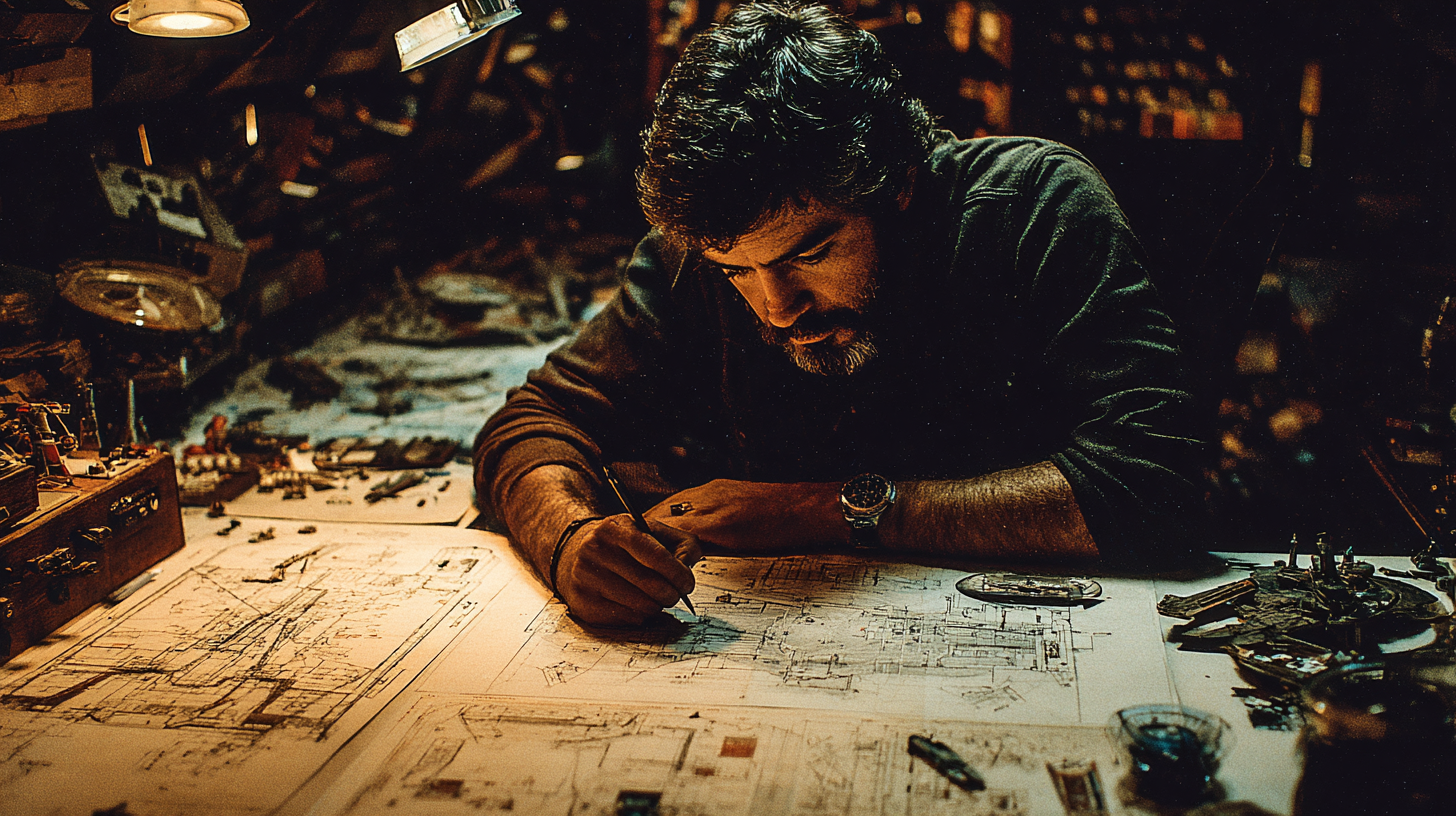
There is a rare category of people who possess the uncanny ability to use their imagination to build vast, immersive universes; they are the Creators.
AI Short movie
When a disappointing grade in creative arts leaves a young girl feeling defeated, her father steps in with a powerful perspective shift. This short film captures an intimate conversation about the true nature of art, moving beyond grades to explore how creativity is fueled by persistence, repetition, and the courage to keep creating. As the father shares his wisdom, a message that feels more and more relevant in this GenAI era, keep watching for a subtle twist at the end of the video.
Extraordinary Beings
There is a rare category of people who seem to operate on a different frequency. These individuals possess the uncanny ability to use their imagination to build vast, immersive universes, worlds governed by their own unique laws, cultures, histories, and geographies. They are the architects of unprecedented cultural phenomena; they are the Creators. While many have tried their hand at world-building, three, in particular, have shaped our modern era more profoundly than any others..
The Ring
The first of these Creators is the Englishman J.R.R. Tolkien (1892–1973), the visionary behind The Hobbit (1937) and The Lord of the Rings (1954–1955). It is no exaggeration to say that these works redefined the fantasy genre forever, leaving an indelible mark on generations of readers and writers alike. I recently gained a deeper appreciation for his journey through Humphrey Carpenter’s definitive work, J.R.R. Tolkien: A Biography, which offers a fascinating look at the man behind the myth.
The Philologist
Tolkien’s work was deeply rooted in his identity as a devout Catholic. He viewed himself not as an ultimate inventor, but as a "sub-creator", believing that while God is the sole absolute Creator, humanity honours Him by exercising its own creative gifts. This philosophical humility was matched by his immense academic pedigree. As a professor of philology at Oxford, Tolkien possessed an extraordinary mastery of language. He was fluent in Greek and Latin from a young age, later mastering Middle English, Welsh, Romance languages like Spanish and French, and even the complex structures of Finnish.
For Tolkien, languages weren't just tools; they were the spark of creation. This passion led him to invent entirely new tongues, most notably Quenya and Sindarin, the high languages of the Elves. These linguistic foundations eventually evolved into his most ambitious undertaking: The Silmarillion. A titanic collection of Middle-earth’s myths and legends, it was a labor of love begun in 1914 that spanned decades, only reaching the public in 1977.
The Lord of the Writers
While his scholarly work continued, Tolkien began crafting stories for a younger audience, most notably The Hobbit (1937). Fascinatingly, he didn’t view himself as the "inventor" of these tales. Instead, he felt he was "discovering" them, as if they were hidden truths revealing themselves to him over time.
Following the massive success of The Hobbit, his publishers naturally clamoured for a sequel. What followed was years of relentless, painstaking labor, resulting in The Lord of the Rings. This wasn't a book he had initially set out to write; rather, it became the grand intersection where the whimsical charm of The Hobbit met the ancient, epic mythology of The Silmarillion.
The result was a masterpiece of unprecedented depth, published in three volumes between 1954 and 1955. While global fame eventually followed, it was a surprise that Tolkien met with characteristic modesty. He never allowed success to alter his quiet life, remaining a dedicated professor and author until the end. Despite his simple habits, he had ignited one of the most significant cultural movements of the 20th century.
The Force
The second Creator hails from the American film industry: George Lucas (born 1944), the visionary producer and director behind the era-defining Star Wars saga. Much like Tolkien’s biography, Brian Jay Jones’s George Lucas: A Life serves as a profound source of inspiration, detailing the grit and imagination required to build a galaxy from the ground up.
"Bleeding on the Script"
Lucas’s path to greatness was far from certain. Following a near-fatal car accident in 1962, he defied his father’s wishes and pivoted toward film studies, a decision that would change cinematic history. His raw talent first captured the public's imagination with the nostalgic hit American Graffiti (1973), but it was his work as a screenwriter that truly tested his resolve.
Despite his creative genius, Lucas famously loathed the writing process; he considered it his "worst nightmare." This agony is perfectly captured in Brian Jay Jones’s biography, where the chapter detailing the Star Wars script is aptly titled "Bleeding on the Page." This gruelling exercise in creation took him nearly three years of relentless effort, stretching from early 1973 to January 1976, with further revisions continuing even as the cameras began to roll.
Control Freak
Beyond his boundless imagination, Lucas possessed a rare shrewdness that ensured the longevity of his work. His primary strategy was absolute control. Having been burned by Universal Pictures during the production of American Graffiti, where the studio imposed numerous cuts against his artistic vision, Lucas was determined never to let history repeat itself.
When negotiating Star Wars with 20th Century Fox, he leveraged his previous success to secure unprecedented terms. He demanded complete creative control, the rights to all future sequels, and, perhaps most importantly, the merchandising rights. At the time, merchandising was largely dismissed by the industry, but for Lucas, it became the foundation of his empire.
This desire to push boundaries also forced him to innovate where technology fell short. He founded Industrial Light & Magic (ILM) and THX, revolutionising special effects and sound engineering while creating sustainable revenue streams that would last for decades. Ultimately, the success of Star Wars wasn't just a stroke of luck; it was a masterclass in combining an extraordinary creative spirit with a pioneering vision and the iron-clad control necessary to realise it.
Piracy
The third Creator hails from Japan: Eiichiro Oda (born 1975), the mastermind behind One Piece, the best-selling manga series in history. While much of his life remains dedicated to his craft, his journey and philosophy are expertly explored by Alexis Orsini in One Piece: La Volonté d'Oda [FR Only], a deep dive into the relentless will and vision of a man who has captivated the world for over a quarter-century.
"The Greatest Artist in the World"
Eiichiro Oda is the visionary behind One Piece, a global phenomenon that has surpassed 500 million copies in circulation, making it the best-selling comic book series in history. At its heart, the story follows a young pirate’s quest to fulfil his dreams, but the scale of the world Oda has built is nothing short of legendary. Another "Extraordinary Being" with a boundless imagination, Oda’s ambition was clear from the very beginning: he didn't just want to draw, he aimed to become the greatest artist in the world.
The Trials of Weekly Shōnen Jump
Unlike Tolkien or Lucas, who both tasted professional success before their magnum opuses, Oda was an unknown quantity when he began One Piece. His journey started on August 4, 1997, in the pages of Weekly Shōnen Jump, the legendary magazine that birthed Dragon Ball. To reach those heights, Oda had to endure the rigorous, often gruelling, traditional publication process.
He began in the trenches as an assistant to established mangaka, refining his craft through "one-shot" stories. Central to his development was his Tantô (editorial manager), a mentor who pushed Oda’s ambition to its absolute breaking point. Every element was subjected to incisive, often brutal feedback: from the fluidity of his drawing style and character silhouettes to the depth of the script and the pacing of the action.
In this world, success is never a given. Every mangaka must first survive the "ten-week rule," where the editorial board grants a story a mere ten chapters to capture the public’s imagination. In a system driven by weekly reader votes, only the most engaging stories survive. Oda didn't just survive this cutthroat environment, he conquered it.
28 Years of Success
Oda spent years sketching, refining, and dreaming into existence what would eventually become his life’s work. His breakthrough came during the week of August 4, 1997; One Piece debuted at a promising 4th place in the reader rankings, but just two weeks later, it claimed the 1st place spot. For a twenty-two-year-old artist in such a competitive field, this was an almost unheard-of achievement.
It was the start of a meteoric rise that has yet to plateau. Nearly twenty-eight years later, Oda continues to work at a relentless pace, producing a new chapter almost every single week (save for essential breaks to preserve his health). His dedication has turned a pirate’s tale into a cultural staple, continuing to captivate and delight multiple generations of passionate readers around the globe.
The Three Creators
These three generational artists have produced the most inspiring and engaging works of our modern cultural era. Yet, it is difficult to imagine three personalities more distinct from one another:
- The Oxford Scholar: An English professor and philologist who built a mythology out of ancient languages and deep-seated faith.
- The Maverick Visionary: The "cool kid" from California who defied the studio system to become the most influential director of his generation.
- The Boundless Artist: An introverted Japanese creator who shuns the spotlight, choosing instead to let his soul speak through his characters and his pen.
Despite their vastly different origins, they share a common thread: an unwavering commitment to their vision and the courage to build worlds where the rest of us can dream.
The Cost of Creation: Working Without Counting the Hours
Behind the magic of these universes lies a staggering amount of labor. Their biographies reveal that all three men are "monsters" of productivity, driven by a work ethic that borders on the superhuman.
Oda’s life is governed by the relentless cycle of weekly publication, a pace that few could sustain for even a year, let alone nearly thirty. Tolkien was no different; he often found himself hunched over his manuscripts until two or three in the morning, balancing his creative world-building with the demanding reality of his duties as an Oxford professor, teaching, grading, and navigating university administration. Similarly, Lucas was known to disappear for days on end, spending entire nights in the editing room, meticulously refining every frame of his films until they matched the vision in his head.
For these Creators, work wasn't a chore; it was the necessary sacrifice required to bring their extraordinary imaginations to life.
The Art of Perfection
Beyond their work ethic, all three Creators are defined by a relentless, almost obsessive perfectionism. For Tolkien, this trait was both a gift and a curse; he revised and rewrote his texts so extensively that he often became lost in a labyrinth of competing versions. This is precisely why the vast majority of his Middle-earth lore remained unpublished during his lifetime.
For Lucas, perfectionism meant maintaining an uncompromising grip on every facet of production. From the rhythm of a script to the specific "chemistry" of a cast and the precision of a sound effect, nothing was too small to ignore. This drive was so strong that it eventually led him to oversee "Special Edition" remasters of his original trilogy decades later, still seeking the "definitive" version of his vision.
Oda displays his perfectionism through narrative complexity. He is a master of "foreshadowing," planting subtle clues and characters that only find their resolution years, or even decades, later. This level of long-term planning is a testament to a mind that refuses to leave any detail to chance, ensuring that every piece of the One Piece puzzle fits perfectly into a grander design.
Dreams, Friendship, and Freedom
Ultimately, the staggering success of these works stems from the timeless themes they explore, concepts that resonate across any language or culture. We find ourselves drawn to the profound bonds of friendship, whether it’s the quiet loyalty between Hobbits, the unbreakable ties of a pirate crew, or the wordless devotion of a Wookiee. We are stirred by the eternal struggle for freedom, the pursuit of light over darkness, and the relentless courage required to chase one's dreams. These are stories of adventure and discovery that transport us through ages and civilisations we never knew existed, yet somehow feel like home.
Tolkien, Lucas, and Oda are, of course, not alone in this endeavour. There are many other men and women who, from the void, create or "discover" these universes, setting heroes in motion to navigate fantastic trials. They do it for us: the readers, the dreamers, and the spectators. To these three giants, and to all the Creators who give us worlds to explore: a profound thank you.